
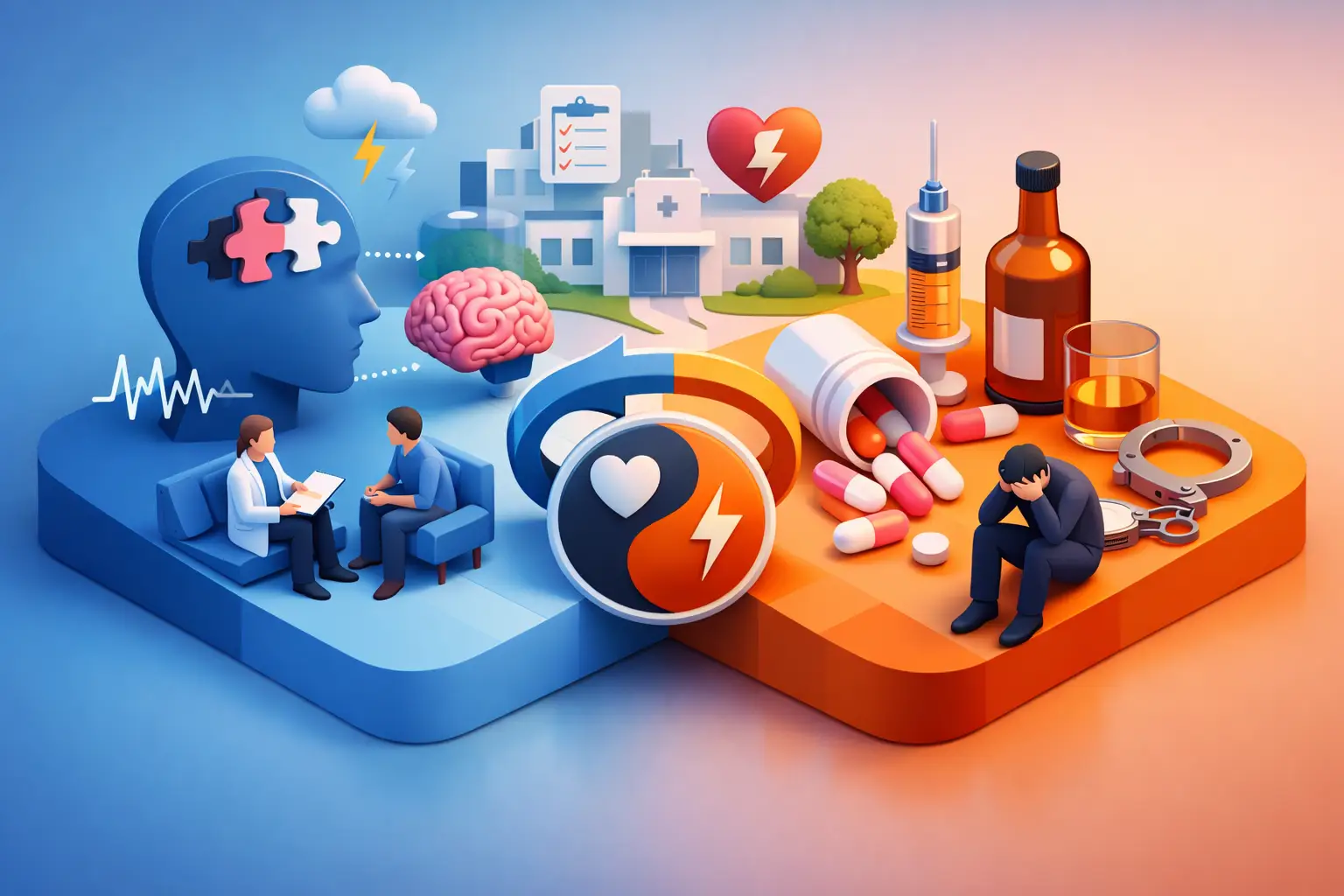
When someone keeps relapsing even after detox or stays sober for a short time but still cannot sleep, regulate emotions, or manage panic, the problem is often bigger than substance use alone. Co-occurring mental health and addiction treatment addresses both conditions at the same time, which is often what makes real recovery possible. Treating one while ignoring the other can leave people stuck in the same cycle, just with different symptoms.
This matters because addiction and mental health conditions rarely stay in separate lanes. Depression can fuel drinking. Anxiety can drive misuse of prescription medication. Trauma can make a person feel constantly on edge, then push them toward drugs or alcohol for relief. At the same time, heavy substance use can intensify paranoia, depression, mood swings, and emotional instability. What starts as self-medication often becomes a pattern that is harder to break without structured help.
What co-occurring mental health and addiction treatment really means
A co-occurring disorder, sometimes called dual diagnosis, means a person is living with both a substance use disorder and a mental health condition. That may include alcohol addiction and depression, opioid addiction and PTSD, methamphetamine use and anxiety, or any number of combinations. The exact diagnosis matters, but the bigger issue is that each condition affects the other.
That is why treatment has to be integrated. If a program focuses only on stopping substance use, the person may leave sober but still overwhelmed by untreated symptoms. If treatment focuses only on mental health without addressing addiction, substances can keep disrupting progress. Integrated care looks at the whole person – behavior, mood, trauma history, coping patterns, physical stability, and daily functioning.
For many adults, especially those with repeated relapse or unstable living conditions, this work is hard to do in an unstructured setting. Early recovery often requires distance from the triggers, chaos, and pressures that keep both disorders active.
Why separate treatment often falls short
People are sometimes told to get sober first and deal with mental health later. In very limited situations, a provider may need to stabilize immediate safety concerns before moving deeper into therapy. But as a broader approach, separating care can create gaps that work against recovery.
A person with untreated anxiety may stop drinking, then find that their nervous system feels unbearable without alcohol. Someone with depression may complete a short program, return home, and struggle to get out of bed, attend appointments, or follow through with support. A person carrying unresolved trauma may stay abstinent briefly but remain reactive, shut down, or emotionally flooded. Without tools to manage those symptoms, relapse can start to feel less like a choice and more like an escape.
This is where accountable, residential care can make a difference. Structure is not about punishment. It is about reducing noise so treatment can begin to work. Regular sleep, meals, group therapy, individual counseling, medication support when appropriate, peer accountability, and a safe environment create the stability many people have not had in a long time.
What effective co-occurring mental health and addiction treatment includes
Good treatment does not rely on one therapy or one breakthrough moment. It is built through consistent clinical care, repetition, and daily practice. The strongest programs assess both substance use and mental health from the start, then adjust the plan as symptoms become clearer.
A thorough assessment should look beyond what substances are being used. It should explore trauma exposure, depression, anxiety, mood instability, past treatment attempts, medical concerns, family history, and current risk factors. This matters because symptoms can overlap. Withdrawal can look like anxiety. Methamphetamine use can resemble severe mood disturbance. Trauma responses can be mistaken for defiance or lack of motivation. Careful evaluation helps prevent oversimplified treatment.
Evidence-based therapies are also central. Cognitive Behavioral Therapy helps clients identify distorted thinking patterns and replace them with more grounded responses. Dialectical Behavior Therapy is especially useful for emotional regulation, distress tolerance, and relationship instability. Motivational Interviewing helps people work through ambivalence, which is common in early recovery. Many adults want help and resist help at the same time. A skilled clinician knows how to work with that tension rather than shame it.
Medication may also be part of care, depending on the diagnosis and the individual. Some people benefit from psychiatric medication to reduce severe depression, anxiety, or mood symptoms. Others may need medication support related to substance use recovery. There is no one-size-fits-all answer. What matters is careful monitoring, clear communication, and treatment that uses medication as one tool within a larger recovery plan.
The role of residential structure in dual diagnosis care
For people whose mental health symptoms and addiction reinforce each other, environment is not a side issue. It is part of treatment. If someone returns every night to conflict, easy access to substances, unstable housing, or total isolation, progress can unravel quickly.
Residential treatment creates a protected space to rebuild basic functioning. Clients can begin to practice routines that support recovery instead of working against it. That includes waking up on time, attending therapy consistently, managing emotions without substances, participating in community, and following through on responsibilities. These may sound simple, but they are often the exact skills addiction, and mental health symptoms have disrupted.
There is also a clinical benefit to observing a person over time. In a residential setting, staff can see patterns that may not show up in a weekly outpatient visit. They can notice sleep changes, emotional triggers, social withdrawal, impulsive behavior, or medication concerns early. That ongoing observation can lead to more accurate treatment and faster adjustment when something is not working.
For families, this kind of setting often brings relief. They are no longer trying to manage every crisis from home while guessing whether their loved one is safe, sober, or spiraling. Instead, recovery happens in a setting built for accountability and support.
How long-term recovery gets built
Stabilization is only the first step. People with co-occurring disorders usually need more than a short interruption in substance use. They need time to build new habits, understand triggers, and practice healthier responses repeatedly enough that those responses become usable in real life.
That is why continuity of care matters. A strong program does not treat discharge as the finish line. It prepares clients for what comes next – transitional housing, ongoing therapy, relapse prevention planning, work therapy, peer support, and life skills development. Recovery is more durable when people move through levels of care with support instead of stepping from high structure straight into total independence.
There are trade-offs here. Not every person needs the same length of stay, and not every mental health symptom requires the same level of intervention. Some clients stabilize quickly and can transition sooner. Others need longer residential support because trauma, chronic relapse, or severe mood symptoms make early recovery especially fragile. Good treatment respects those differences without lowering expectations.
In the Phoenix area, many adults come into care after trying outpatient treatment, detox, or repeated promises to change on their own. What they often need is not another brief reset. They need a place where recovery has structure, mental health is taken seriously, and accountability is part of daily life.
Signs a person may need integrated treatment now
Families and individuals often wait too long because they are trying to decide which problem is the “real” one. Usually, that is the wrong question. If substance use and mental health symptoms are both present, they both need attention.
Integrated treatment may be necessary when someone uses drugs or alcohol to cope with anxiety, depression, trauma, or mood swings. It is also a strong fit when relapse keeps happening after treatment, when emotional instability makes daily life hard to manage, or when a person cannot maintain sobriety without a highly structured environment. Suicidal thinking, self-harm, paranoia, severe isolation, or dramatic changes in behavior should always raise the urgency.
At Step One Behavioral & Residential, this kind of care is grounded in the belief that people recover best when treatment combines clinical skill, daily structure, and a community that expects growth. That approach is especially important for adults whose addiction and mental health symptoms have been feeding each other for years.
No one becomes more stable through chaos. No one builds lasting recovery by treating only half the problem. The right setting can give a person enough safety, structure, and support to stop surviving from one crisis to the next and start rebuilding a life they can actually sustain.
James Mcreary, LPC-S, Clinical Director Step One Behavioral & Residential
James Mcreary helps oversee the clinical direction of the residential treatment program, supporting evidence-based care, accountability-focused recovery programming, and treatment planning for adults facing substance use and co-occurring behavioral health challenges