
Residential Treatment vs Sober Living: Understanding the Recovery Continuum
The discharge planner at Step One asks every person the same question during the first week of residential treatment: “Where will you sleep the night you leave here?” It is not because housing alone determines recovery success. It is because people who answer “I don’t know” or “back to my old place” face different challenges than those who transition into structured recovery housing with continuing outpatient care, peer accountability, an employment plan, and the same case manager they met in residential. Individual outcomes vary based on many factors.
If you are researching options for someone you love, you have probably run into the same confusion most families do. You keep seeing two phrases, residential treatment vs sober living, and the internet treats them like two separate products you pick between. They are not. They are two stages of the same recovery continuum, and the space between them is where some people encounter challenges. Understanding how the two connect may help your loved one navigate the transition from a program into rebuilding a life.
Residential Treatment vs Sober Living: What Residential Care Provides That a Sober Home Does Not
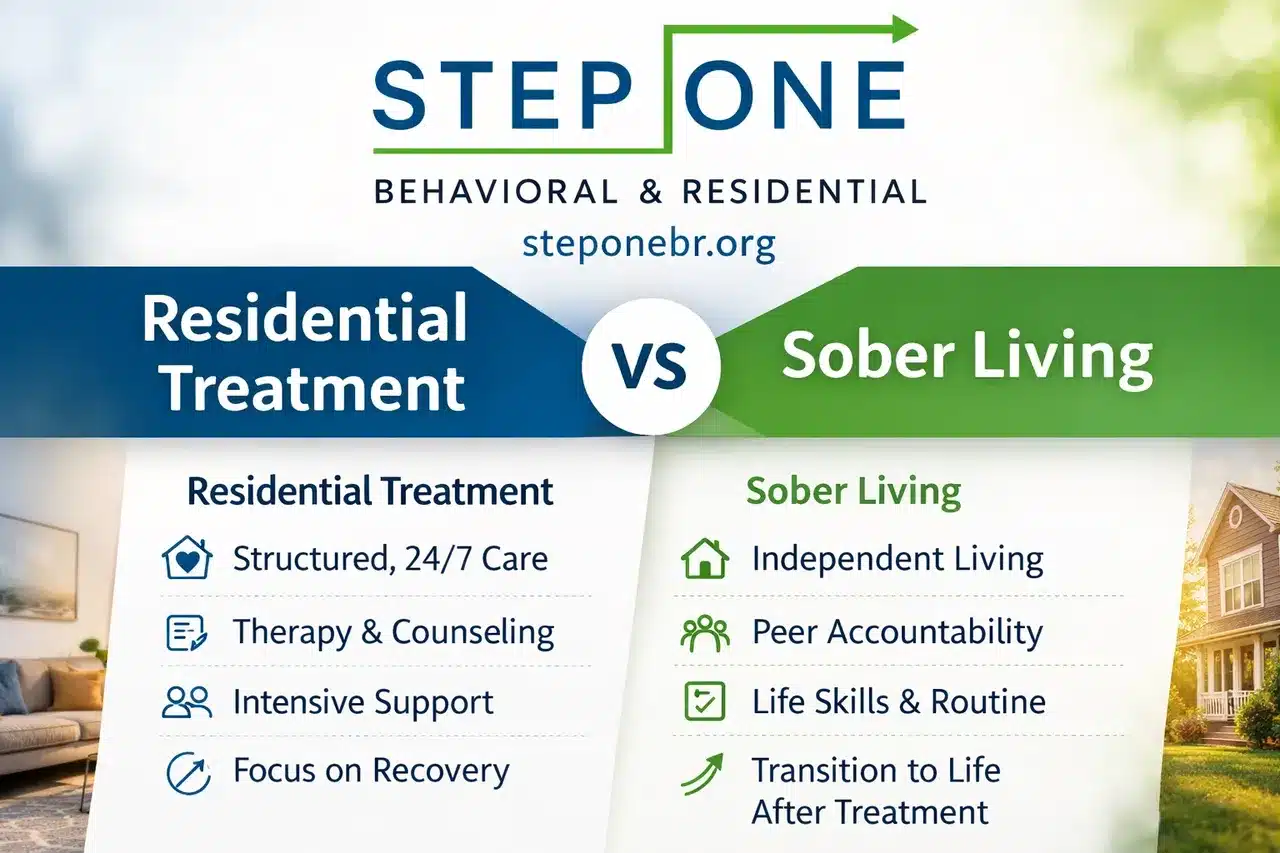
Residential treatment is clinical care. Sober living is supportive housing. That single distinction explains much of what families need to understand when they weigh residential treatment vs sober living.
Step One operates as a licensed Behavioral Health Residential Facility (BHRF) in Phoenix, Arizona. That license means something specific. Inside residential care, a person receives 24-hour nursing oversight, medication management handled and administered by staff, individual and group therapy, crisis intervention when difficult moments arise, and interdisciplinary clinical review of their case every week. A sober home does not provide any of that. A sober home provides a substance-free place to live with peers who are also in recovery, offering a sense of community. Both serve important roles. They simply do different jobs.
This is why the length of a residential stay is not a number picked in advance. Step One does not run a fixed 30-day program with the clock started on admission. The treatment team decides when someone may be ready to step down using the ASAM Criteria, the placement framework published by the American Society of Addiction Medicine. That review looks at medical stability, psychiatric stability, how well the person functions day to day, and relapse risk factors. A person with active withdrawal risk, an unmanaged co-occurring mental health condition, or challenges with basic daily living may benefit from the higher level of care first. Sober living typically serves people who have achieved greater stability in these areas.
Think of it the way you would think of any serious health condition. You would not send someone home from the hospital with a supportive roommate before the medical team confirmed the crisis had passed. Residential care is where acute needs are addressed. Recovery housing is where ongoing recovery skills can be practiced. Individual responses to treatment vary.
How Sober Living May Support the Transition After Treatment
The first ninety days after residential treatment ends present particular challenges in early recovery. The National Institute on Drug Abuse has documented that substance use disorders are chronic conditions with relapse patterns comparable to those of other chronic conditions like hypertension and asthma, which is why continuing care is an important consideration. Sober living exists to provide structure and support during the transition to independent living, rather than an abrupt change the day someone leaves residential care.
At Step One, recovery housing includes a written continuing care plan. When a person moves from residential into the recovery housing operated by the same nonprofit, that plan typically includes scheduled outpatient or intensive outpatient therapy, a medication follow-up appointment within seven days of transition, weekly case management contact during the first month, and a minimum of three peer-support meetings per week. Curfew during the first 30 days is 10:00 PM Sunday through Thursday and 11:00 PM Friday and Saturday, adjusted only for a verified work schedule or an approved treatment activity.
The accountability structure includes at least one random drug screen per week during the first 30 days, with additional screening when clinically indicated. Residents are expected to begin work, school, vocational training, or volunteer service, and anyone not yet employed provides documentation of an active job search within 14 days, unless the team approves a different plan for medical or legal reasons. This is what distinguishes clinically connected recovery housing from an unstructured sober home, where a person may face challenges without structured support.
That structure provides a gradual transition. A person leaving 24-hour care may benefit from continued support, loosened gradually as they demonstrate increasing independence. Quality recovery housing allows people to practice independence while maintaining accountability and connection to care. Individual experiences vary.
When Someone May Be Ready to Step Down
Readiness for sober living is not a certain number of sober days. It is assessed based on stability across the areas the ASAM Criteria measures, evaluated over time by a clinical team.
Step One’s interdisciplinary team pays particular attention to two dimensions. Dimension 3 covers emotional, behavioral, and cognitive conditions: mood stability, coping skills, and safety considerations. Dimension 5 covers relapse potential: whether the person has developed and demonstrated relapse prevention skills. A third area, the recovery environment, often remains a consideration even after a person shows progress in other areas, which is why recovery housing exists as a transitional option rather than an immediate return to an unstable home.
Here is what makes this different from a one-time checklist. The team reassesses readiness weekly using nursing observations, therapist assessments, case management input, medication adherence, and the person’s actual behavior in the program. The team looks for whether the person can perform daily living tasks with minimal supervision, follow the daily routine, participate appropriately in individual and group therapy, work on emotional regulation, and articulate a realistic plan for housing, work, and outpatient follow-up. The team seeks to observe consistency over time rather than a single good week.
To make this concrete, consider a composite example our clinical team offers, drawn to illustrate the process rather than any one person. An adult man was admitted after medical clearance for severe alcohol use disorder, with co-occurring anxiety and depression, and no stable place to live. Early on, his needs in several ASAM dimensions were significant. Over roughly 35 days he participated in counseling and group, took his medication as prescribed, worked on identifying triggers, and developed a personal relapse prevention plan. When the team reviewed his case, his mood had shown improvement and certain risk factors had decreased. His living environment still needed support, so he stepped down into recovery housing with outpatient services and a medication follow-up already scheduled. Most stays land in the 30 to 45 day range, though duration is based on individual clinical need. Individual outcomes vary.
Why Planning for the Transition Starts in the First 72 Hours
The gap most families are concerned about, an abrupt end of care when a program finishes and no one has arranged what comes next, does not happen by accident. It happens when discharge planning is left for the final week. Step One addresses this by starting planning at admission.
Within the first 72 hours of a residential admission, the treatment team opens a continuing care plan. That early plan identifies potential recovery housing placement, workforce or vocational referral options, outpatient behavioral health appointments to schedule, medication reconciliation needed for after discharge, and peer recovery resources. None of this waits. The plan is then refined through weekly treatment reviews as the person’s needs become clearer, and it is finalized before the transition, not assembled at the last moment.
This matters because the transition between levels of care is a critical period in recovery. Medication reconciliation is completed before a person leaves residential care, and they leave with an adequate supply of prescribed medication or the prescriptions in hand. The first outpatient prescribing appointment is scheduled before discharge, typically within seven days when clinically appropriate. For anyone receiving Medication-Assisted Treatment, dosing is coordinated to avoid interruption during the move to the next level of care.
For you as a family member, this is what coordinated care looks like. You are not left searching for a sober home the week before discharge, hoping to find an open bed and wondering about coordination with the treatment just received. A transition plan is developed throughout the stay, because the goal is to support long-term recovery, and that requires planning for where someone lives after residential care.
Same Case Manager, Same Mission, One Continuum
Phoenix has a large recovery housing market, and the quality varies widely. Many sober homes have no connection to any clinical provider. A person completes treatment at one facility, receives a list of housing options run by unaffiliated organizations, and begins again with people who were not involved in their care. Each transition is an opportunity for disconnection.
Step One was built to address that gap. Our recovery housing is part of the same nonprofit organization that operates the licensed residential facility. That means a person may keep the same case manager they met in residential, continue outpatient treatment through the organization or a coordinated referral, and transition gradually toward employment and independent living with accountability structures in place. The relationship does not reset. The clinical history is maintained. The professional who learned about your loved one’s needs in week one continues to check in during month three.
This continuity is anchored in more than 23 years of nonprofit service to the Phoenix community, addressing addiction and housing instability together rather than treating them as separate issues. That history is reflected in the work therapy and vocational recovery program, which helps people work on rebuilding employment skills and work history. It shows up in the mission itself, which focuses on supporting individuals in long-term recovery. Step One accepts AHCCCS and offers private pay options. Residential treatment is generally covered as a medical service by AHCCCS and many private insurers, while recovery housing is typically a separate self-pay arrangement that the team helps coordinate alongside covered outpatient services.
The difference appears in everyday moments. A missed appointment is noticed because the same person is tracking engagement. A difficult week may be identified early because accountability has not lapsed. That is what an integrated continuum offers that fragmented services cannot, and it is central to the residential treatment vs sober living question: not which one you choose, but how well the two are connected.
How to Consider Which Level of Care Your Loved One May Need Now
Start with one honest question: can this person safely work on recovery without around-the-clock nursing, psychiatric oversight, and structured daily programming? If the answer is no, residential treatment may be the medically appropriate starting point. If medical and psychiatric stability are already established, sober living may be worth considering.
Certain signs suggest a need for residential care. Active or recent withdrawal, a co-occurring mental health condition that is not stable, thoughts of self-harm, challenges with basic daily living, repeated relapses despite efforts to maintain sobriety, or a home environment with significant triggers may all indicate that 24-hour care is appropriate. Placing someone in supportive housing before they have achieved certain baseline stability may create additional challenges.
Similarly, learn to evaluate recovery housing options for clinical coordination. Ask providers direct questions. Who arranges the outpatient appointments, and are they scheduled before move-in? Is there a named case manager, and did that person work with the resident during treatment? How often is drug screening done, and what happens if someone relapses? If a relapse occurs at Step One’s recovery housing, the response is an immediate professional clinical assessment, a possible return to a higher level of care if medically needed, and continued case management, not automatic eviction. A home that cannot answer these questions clearly is offering housing without integrated recovery support. This is important context for the residential treatment vs sober living consideration.
You do not have to determine the appropriate level of care alone. Call Step One’s admissions team at (602) 247-8505 to discuss whether your loved one may need residential treatment now or might be ready for sober living, and how the integrated continuum supports the transition between the two. Ask specifically about the continuing care plan and about how discharge planning starts from day one.
Frequently Asked Questions
Can someone go directly to sober living without residential treatment?
Sometimes. A person who is medically and psychiatrically stable and does not need 24-hour supervision may enter recovery housing directly. However, individuals with active withdrawal risk, a co-occurring mental health crisis, or significant challenges with daily living independence may benefit from residential care first. A screening call with the clinical team is recommended to determine which level of care may be appropriate. Individual needs vary.
How long does someone typically stay in residential treatment before moving to sober living?
There is no fixed number. Step One makes this determination based on an ASAM Criteria review of medical, psychiatric, functional, and relapse-risk factors, reassessed weekly. Many stays fall in the 30 to 45 day range, though individual needs may result in shorter or longer stays. The person steps down when 24-hour care is no longer medically indicated, not based on a predetermined calendar.
What happens if someone relapses in sober living?
Relapse triggers an immediate clinical assessment. If a higher level of care is medically appropriate, the person may return to it, and case management continues throughout. Because recovery housing is connected to the clinical team, relapse can be identified and addressed with clinical support rather than automatic discharge. Individual responses vary.
Does insurance cover both residential treatment and sober living?
Residential treatment is generally covered as a medical service by AHCCCS and many private insurers. Recovery housing is typically a separate self-pay housing arrangement. Step One’s integrated model allows the team to coordinate covered outpatient services alongside recovery housing, and the admissions team can explain what your specific plan may cover.
Can family members visit during residential treatment and sober living?
Residential treatment includes structured family programming and scheduled visits, with policies designed to support each person’s care. Recovery housing offers more flexibility as a person progresses in recovery, within the house rules and curfew structure. The admissions team can explain the current visitation details for each level of care.
What distinguishes Step One’s sober living from other recovery housing in Phoenix?
It is part of a licensed residential treatment continuum, not a standalone housing option. Residents may keep the same case manager, follow coordinated outpatient appointments, have medication follow-up scheduled within seven days, and participate in employment and vocational programming. As a nonprofit with more than 23 years of service, the mission focuses on supporting long-term recovery. Individual experiences and outcomes vary.
Find the Right Level of Support for Your Recovery
Choosing between residential treatment and sober living depends entirely on where you are in your journey and what kind of structure you need right now. If you’re uncertain whether intensive residential care or a transitional living environment makes sense for your personal situation, a conversation with someone who understands the recovery continuum can bring clarity. Step One in Phoenix is here to walk you through your options, helping you take the next step with confidence.